Noorani Qaida, Quran Reading, Tajweed or Hifz: Where Should Your Child Start?
· Muhammad Abu Baker Siddique · 7 min read
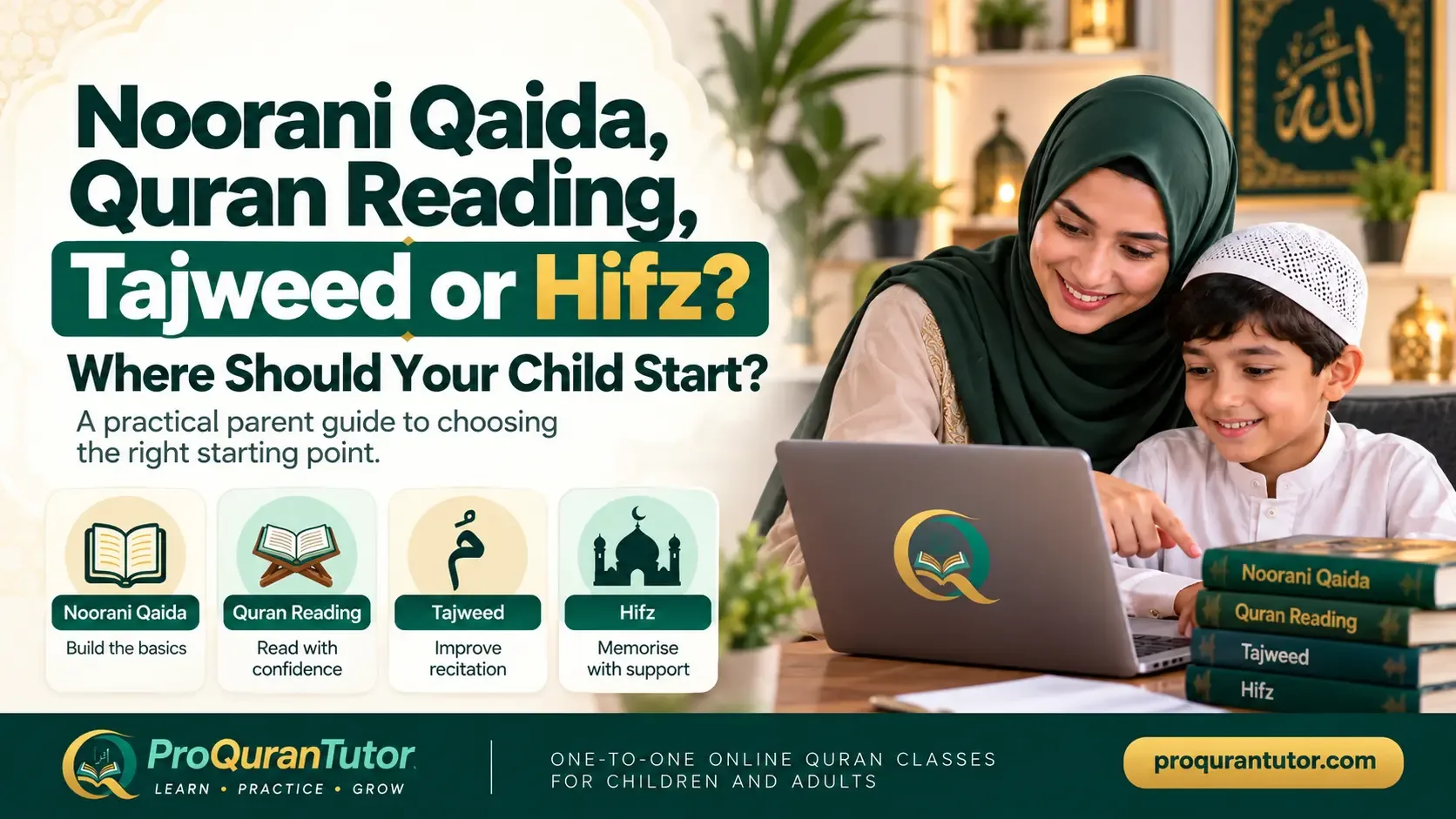
Parents often know that they want their child to learn the Quran, but choosing the right place to begin can be confusing.
Should a beginner start with Noorani Qaida? What if a child can already read some Arabic? Should Tajweed come later? And when is it appropriate to focus more seriously on Hifz?
There is no single answer for every child.
The right starting point depends more on the child’s current ability, previous learning, confidence and learning goals than on age alone.
This guide can help parents understand the main learning paths and what to look for before choosing the next step.
Start by Looking at What Your Child Can Already Do
Before choosing a course, first consider your child’s current level.
Can they recognise Arabic letters confidently?
Can they read letters when they are joined together?
Can they follow a line of Quranic text without constant help?
Have they learned Noorani Qaida before?
Are they already able to read but struggling with pronunciation or fluency?
Have they memorised some Surahs but find revision difficult?
These simple questions usually tell us more than the name of a course.
A child who has studied before may not need to start again from the beginning. At the same time, completing a Qaida once does not always mean that every reading skill is fully secure.
The aim should be to find the next useful step, not simply the next course name.
When Noorani Qaida May Be the Right Starting Point
Noorani Qaida can be a useful starting point for children who are still building the foundations of Quran reading.
It may suit a child who:
- is still learning to recognise Arabic letters;
- confuses similar-looking letters;
- finds joined letters difficult to read;
- has had little previous Quran-reading instruction;
- needs to rebuild confidence in the basics.
The purpose should not be to rush through the Qaida.
A stronger foundation can make later Quran reading easier and reduce the need to repeatedly correct basic reading problems.
For some children, this stage may take longer than for others. That is normal. Progress should be based on understanding and reading ability rather than simply finishing pages quickly.
When a Child May Be Ready for Quran Reading
A child who already recognises Arabic letters and can read joined words may be ready to spend more lesson time reading directly from the Quran.
At this stage, a teacher can observe how the child reads and identify where support is needed.
For example, the learner may:
- read correctly but very slowly;
- hesitate frequently;
- struggle with particular letters or sounds;
- lose their place while following a line;
- need regular correction while reading aloud;
- understand the basics but lack confidence.
The goal at this stage is usually to develop more accurate, steady and confident reading.
A child does not need to be a perfect reader before moving forward. What matters is that the teaching remains appropriate to the student’s actual level.
Where Does Tajweed Fit?
Parents sometimes think Tajweed must be treated as a completely separate stage after Quran reading.
In practice, pronunciation and careful recitation can be developed gradually alongside reading.
For a beginner, the teacher does not need to overload the child with technical terminology. Appropriate correction and simple guidance can be introduced as the learner progresses.
As the student’s reading becomes stronger, Tajweed teaching can become more structured and detailed.
The important point is that the child should not only hear the names of rules. They should gradually learn how to apply the guidance correctly while reading.
When Should a Child Begin Hifz?
Hifz is not simply the next stage after finishing a reading course.
Some children begin memorising shorter portions while they are still improving their reading. Others may benefit from strengthening reading and pronunciation first.
Before moving towards more structured Hifz, it is useful to consider:
- the child’s current reading ability;
- pronunciation and recitation;
- ability to concentrate;
- willingness to revise regularly;
- available practice time at home;
- how well previously memorised material is being retained.
Memorisation should not become a race.
Learning new material is only one part of Hifz. Regular revision and retention are also important parts of the learning process.
A suitable Hifz plan should therefore reflect the individual student’s ability and routine.
What If My Child Has Studied Before but Still Struggles?
This is a common situation.
A child may have completed Noorani Qaida but still hesitate while reading the Quran.
Another student may read reasonably well but need more focused pronunciation work.
A child may also have memorised several Surahs but struggle to retain them without frequent revision.
In these cases, restarting everything from the beginning is not always necessary.
The better approach is to identify the specific gaps first.
A teacher can listen to the student, see what they can do independently and decide where extra attention is needed.
This is one of the benefits of one-to-one Quran learning: the lesson can be adjusted around the learner instead of forcing every child through exactly the same path.
Age Matters, but It Is Not the Only Factor
Parents often ask what a child should be learning at a certain age.
Age can affect lesson length, teaching style, attention span and expectations, but it does not automatically determine the student’s Quran-learning level.
Two children of the same age may have very different backgrounds.
One may already be reading directly from the Quran.
Another may still be learning Arabic letters.
A third may read confidently but need help improving pronunciation or revision.
Instead of asking only:
“What should my child be learning at this age?”
it can be more useful to ask:
“What can my child do confidently now, and what should they work on next?”
A Simple Way to Understand the Learning Path
The learning journey may look broadly like this:
Building the foundation
Learning Arabic letters, joined forms and basic reading through Noorani Qaida where needed.
Developing Quran reading
Reading more accurately, confidently and consistently.
Improving recitation
Working progressively on pronunciation and relevant Tajweed guidance.
Memorisation and revision
Learning selected portions and, where suitable, moving into a more structured Hifz programme.
These stages can overlap.
A child may be improving reading, receiving Tajweed correction and memorising short Surahs at the same time.
The balance should depend on the student.
How Parents Can Support the Learning Process
The right starting point matters, but what happens between lessons also makes a difference.
A regular routine, a suitable learning environment and calm encouragement can help a child stay consistent without making Quran learning feel like unnecessary pressure.
For more practical ideas, read our guide on how parents can support a child learning Quran online.
Questions Parents Can Ask Before Choosing a Starting Point
Before enrolling your child, consider:
- Can my child recognise Arabic letters confidently?
- Can they read joined Arabic words?
- Can they follow Quranic text independently?
- Do they frequently hesitate while reading?
- Have they completed Noorani Qaida before?
- Do they need help with pronunciation?
- Have they already memorised any Surahs?
- Can they revise and retain what they have memorised?
- Are they comfortable reading aloud to a teacher?
- What part of Quran learning do they currently find most difficult?
You do not need to answer all of these questions perfectly.
A teacher can help identify the child’s current level during an introductory lesson.
Choosing the Right Starting Point
The best starting point is not necessarily the most advanced course.
It is the point that matches the learner’s current ability and next learning need.
For one child, that may mean beginning with Noorani Qaida.
For another, it may mean reading directly from the Quran with regular correction.
Another child may need more focused Tajweed support, while a student who already has a suitable foundation may be ready for structured memorisation and revision.
At Pro Quran Tutor, we provide one-to-one online Quran learning for children and adults, including Quran reading, Noorani Qaida, Tajweed and Hifz support.
A free trial class can help us understand the student’s current level and gives the family an opportunity to see whether the teacher and learning arrangement are suitable.
Not sure where your child should begin?
Book a Free Trial Class and let us understand your child’s current Quran-learning level before deciding the next step.
Noorani Qaida quran reading Tajweed hifz parent guidance